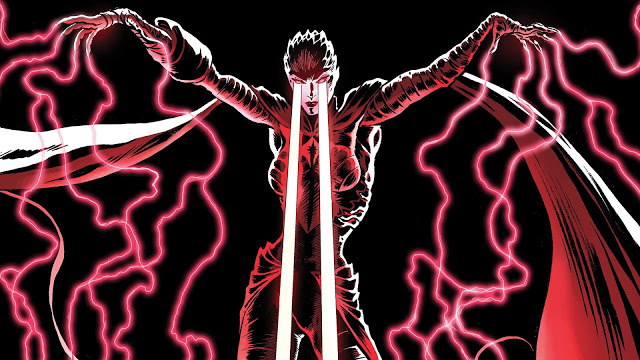
And we’re back with the fourth issue of Grant Morrison and Liam Sharp’s cosmic epic The Green Lantern. This is another exciting issue which provides background on where the Blackstars located the Anti-Matter Lantern, gives us more insight into the mysterious Commander of the Blackstars, Countess Belzebeth, and pits the Corps against Sun-Eaters.
Liam Sharp’s cover for The Green Lantern #4
Here’s where you can find my previous The Green Lantern Deep Dives:
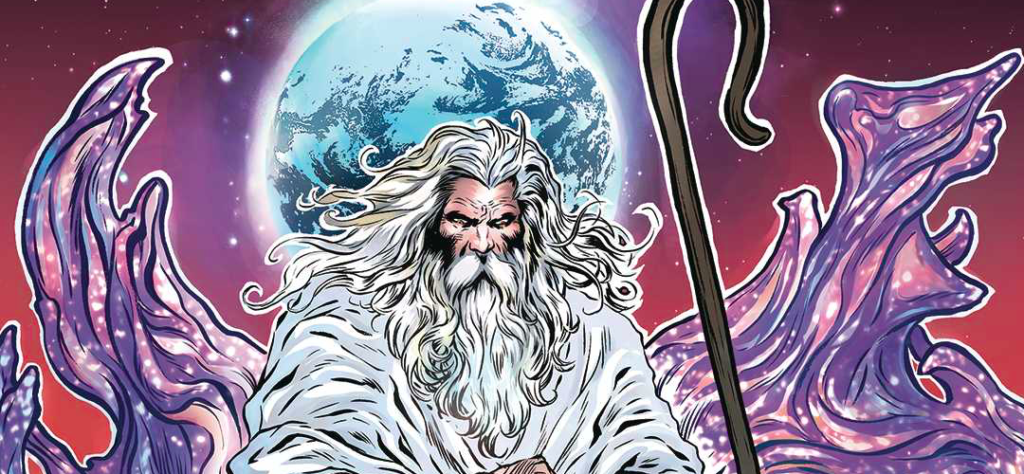
We’ve reached the third issue of Liam Sharp and Grant Morrison’s The Green Lantern and, wowza, is it a doozy. This one is a little more compact in scope. It mostly takes place at a Dhorian planet auction and aboard the spaceship of this issue’s main antagonist, The Shepard. What it lacks in locales it more than makes up in character appearances.
Cover The Green Lantern #3 | Art: Liam Sharp
Before we start gutting this issue here are the links for the previous deep dives.
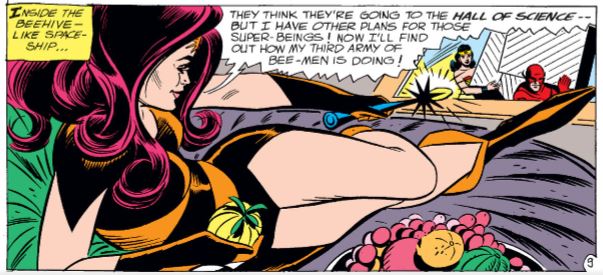
There are several Queen Bee’s in the DC Universe but there’s only one Zazzala of Korll. Queen Bee was a mostly forgotten Silver Age Justice League villain until Grant Morrison brought her back in the pages of his run on JLA.
Queen Bee Justice League of America #23 | Words: Gardner Fox | Art: Mike Sekowsky
Created by Gardner Fox and Mike Sekowsky, her first appearance was in Justice League of America #23. Queen Zazzala hides a machine in the core of the Earth and threatens to blow up the planet unless the League helps her acquire an elixir of immortality (blackmailing the JLA into helping was a fairly common trope in those early days of comics). They don’t have a choice, so they agree to become “drone-workers” and help the villain. The team locates the vial but before handing it over Green Lantern secretly uses his power ring so she’ll never be able to open it (this is a questionable plan).
The Green Lantern issue 2 was released on December 5 and, much like the first issue, has been met with wide critical acclaim. The story is packed with nods to DC history and little nuggets suggesting a larger mystery is unfolding in the background. Once again, I’ve attempted to dive deep into the ink to puzzle out and annotate the many references Liam Sharp and Grant Morrison have packed into the issue. If something previously appeared in the deep dive for The Green Lantern #1 I’ll refer you to that post for the meat, but will add any second issue specific comments below. If something is new it’ll receive the full annotated The Green Lantern treatment.
Grant Morrison’s The Green Lantern issue 1 hit shelves in November 2018. The highly anticipated comic, with beautiful art and design by Liam Sharp and stunning colors by Steve Oliff, is Morisson’s first time writing Hal Jordan and diving into the rich history of the Green Lantern Corps. The writer, who’s previously tackled Wonder Woman, Batman, Superman, and the JLA, is notorious for his encyclopedic knowledge of DC canon and how he uses that knowledge to pack obscure references into his stories. This monthly feature (over)analyzes each issue and seeks to provide context and history to the characters, places, and things. So make yourself a Hal Jordan cocktail and enjoy this annotated break down of Grant Morrison and Liam Sharp’s The Green Lantern issue 1.
Seeing as this is issue one, we first need to catch everyone up on how Hal Jordan ended up where he is at the start of The Green Lantern issue 1.
How we ended up here.
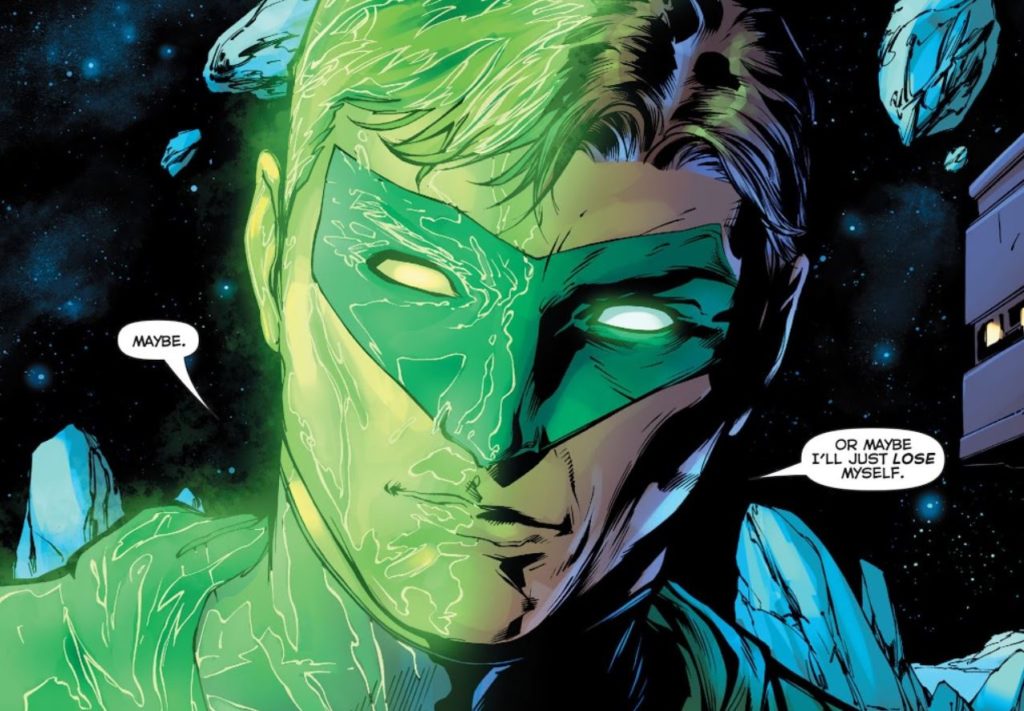
Hal Jordan’s been having a rough few years. A sacrifice was required after a series of incidents that basically turned the Universe against the Green Lantern Corps. That sacrifice was the leader of the Corps, Jordan, who made himself a fall guy to save the reputation of the Lanterns. Working under secret orders from the Guardians he stole Krona’s power gauntlet from the Corps and went on the lam. During this time, the Corps disappeared from this Universe for an assortment of complicated reasons. Jordan’s continued use of the gauntlet slowly starts to transform him into the living embodiment of Will.
Hal Jordan becomes living Will. Green Lantern Vol. 5 Issue 52 Art: Billy Tan | Color: Alex Sinclair
In an effort to save himself, he uses the last bit of his true self to become the first non-Guardian to craft a power ring. It was a badass moment in Jordan history (Hal Jordan and the Green Lantern Corps: Rebirth).
He manages to find the Corps and bring them back. Their numbers are significantly reduced, so they need to rebuild. This effort is documented in Hal Jordan and the Green Lantern Corps which ends with an epic battle against the Darkstars. In order to beat the Darkstars, the Corps teams-up with unlikely allies including General Zod, Hector Hammond, and Orion of the New Gods. Phew.
After all of this Jordan is understandably exhausted and decides to head back to Earth for some “unfinished business.” Hal Jordan and the Green Lantern Corps concludes with Jordan darkening the doorstep of Carol Ferris. They make-out. End scene….
but wait! It doesn’t end there. His story continues in Green Lanterns. After what seems to be a rather short time reuniting with his longtime on-again-off-again girlfriend, Jordan decides to go on a trip to Space Sector 066 to unwind some more. His vacation is short-lived when the Corps finds itself against the wall thanks to a brilliant bit of subterfuge by Hank Henshaw, a.k.a Cyborg Superman, and the Ravagers.
The story, by Dan Jurgens, is a long overdue full circle redemption moment for Jordan. For the last *squints and cries* 25 years, the destruction of Coast City and the resulting fallout has sort of been a weight around Jordan’s neck. In Green Lanterns, Henshaw is hell-bent on once again reducing Coast City to rubble. This time, Jordan, with the help of a cadre of Lanterns, is strong enough to defend his home city. Henshaw finds himself on the verge of losing to the Lanterns and is forced to flee with the Phantom Ring.
Here’s the status of the Corps right before Morrison picks up the storyline:
In this modern age of comic-influenced pop culture we’re neck deep in shared universes and, increasingly, shared multiverses. It can be hard to imagine a time when that wasn’t the case. It can be even more difficult to believe we didn’t see the first true comic book shared universe until the mid-1960s. That’s when the daughter of the third most important character to debut in Action Comics #1 arrived on the scene in a quest to find her father. Zatanna’s search would take her on a winding path through six DC titles. As a result, it impacted several heroes and had repercussions on the DC Universe as a whole.
Justice League of America Vol. 1 #51
Characters with their own titles crossing over with other characters is a common occurrence going all the way back to the birth of superhero titles. It’s difficult to pinpoint who can lay claim to the first ever superhero crossover.
The honor could possibly go to Lev Gleason Publications in 1940. That publisher teamed up the characters Silver Streak and Daredevil (not that Daredevil). It just barely preceded the first known team up of Marvel characters. Marvel Mystery Comics #8 featured Namor and Human Torch going head-to-head for the first time. For DC characters, the first crossover medal goes to All-Star Comics #3 which saw the first appearance of the Justice Society of America. At the time, it was likely the biggest crossover in terms of number of characters featuring Flash (Jay Garrick), Green Lantern (Alan Scott), Hawkman (Carter Hall), Spectre (Jim Corrigan), Hourman (Rex Tyler), Sandman (Wesley Dodds), Doctor Fate, and Atom (Al Pratt).
If you’re creating a Hal Jordan cocktail you can’t get much more on the nose than making it an Aviation variation using Aviation American Gin. Whitechapel‘s Megan Daniel did exactly that for Virgin Atlantic’s Clubhouse pop-up bar at London Cocktail Week.
The San Francisco bartender took top prize at Virgin Atlantic’s cocktail competition. The fierce but friendly competition asked 13 bartenders to create an original cocktail using Aviation Gin as the base spirit. Daniel’s Hal Jordan cocktail, a riff on the classic pre-Prohibition era Aviation cocktail, is described by Virgin Atlantic as “a beautiful riff on the classic Aviation. Simple and elegant in presentation.”
Whitechapel’s Megan Daniel builds a Hal Jordan cocktail. Photo courtesy of Virgin Atlantic’s Ruby blog.
She stirred together a combination of Aviation American Gin, Pomp and Whimsy gin liqueur, Maraschino Luxardo, and lemon bitters. The cocktail bearing the alias of the first Green Lantern Space Sector 2814 will be served in Virgin Atlantic clubhouses around the globe.
As mentioned above, when it comes to designing a cocktail after Hal Jordan using Aviation American Gin in a Aviation variation is an inspired concept. In the comics, prior to becoming a member of the Green Lantern Corps and for a time while concealing his identity on Earth, Jordan is a fearless aviator. The base spirit of the cocktail, Aviation American Gin, is partially owned by Ryan Reynolds. The actor famously portrayed Hal Jordan in the 2011 Green Lantern film.