The always affable Nick Dragotta, who's currently blowing minds illustrating East of West, will be signing at Escapist Comics on Saturday. Dragotta will be making his in-store appearance on April 12…
The 20th anniversary of the Asian-American pop arts and culture magazine Giant Robot is coming to the Oakland Museum of California in the form of a three month long exhibit.…
Wonder Woman is going to be performing at Yoshi's in San Francisco! Well, sort of. Lynda Carter, who popularized Wonder Woman in the live action television series, will be performing…
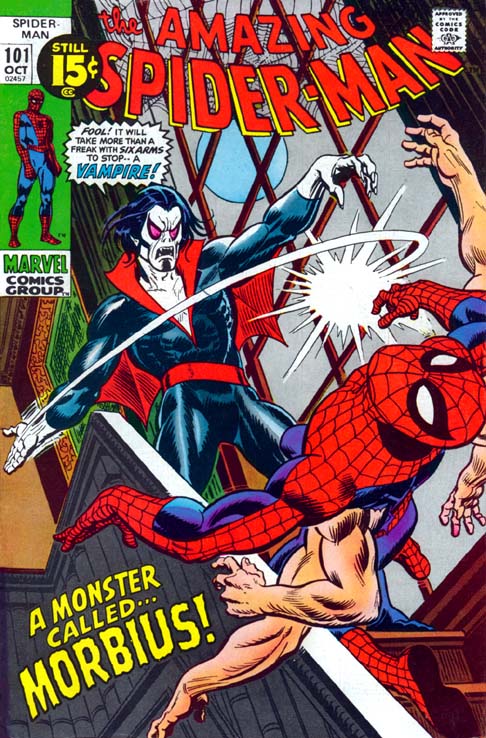
Oh right. Spider-Man once had six arms. That happened.
Contrary to the possible misrepresentation of Sony Co-Chair Amy Pascal’s comments, an expanding Universe based solely around Spider-Man has a great deal of potential. Yes, there is a risk of Spideyverse exhaustion (although the reboot being so successful in spite of it being less than five years after the Raimi trilogy suggests otherwise), but I believe Pascal was suggesting Spiderverse-based films that don’t necessarily include Spider-Man. Unfortunately, with superhero films, we’re locked into the blockbuster mentality. That’s why I think Sony may be the best bet when it comes to breaking open a larger Spider-Man Universe. Sony has shown by continuing franchises like Resident Evil and Underworld that they’re comfortable with their subsidiaries occasionally turning a profit of less than $100 million. This is where I see many of the Spideyverse spin-off films falling. Again, this all comes down to who has the rights to the below characters.
(note: this is part two in a series exploring why we don’t need the X-Men and Spider-Man in the Marvel Cinematic Universe. See part one here.)
My life's been better since I learned to stop worrying and accept the Marvel films rights status quo. If all of the heroes were under the Disney/Marvel roof it'd be…
Not comic book related, but a very worthy mention for one of the coolest indie movie theaters in the United States. Oakland's New Parkway is raising money to put a…
Why did I invest in the Kickstarter for Jason McNamara and Greg Hinkle's horror graphic novel The Rattler? Because if I'm going to trust anyone to put out a solid…
It was a strange and fruitful blip in the online comic community. Writer Warren Ellis’s comic book message board The Engine ran from early September 2005 to Aug. 31, 2007, birthing in its short life new comic books, ongoing collaborative superteams, Eisner and Harvey Award-winning projects, and at least one marriage.
My affectionate memories are not only those of a participant, but of one of six hand-picked moderators (or Filthy Assistants, or Enforcers, or Attack Wombs, or…) from its birth to retirement. I spent hours a day reading, enforcing, and talking Engine, so it looms large in my memory as a crucible of comic history. The Engine was uniquely suited to making things happen, not just talking about them, and I’m heading back into the mid-aughts to explore what made it such fertile ground and why its echoes affect comics to this day.
The Engine logo by Brian Wood
“The measure of intelligence is the ability to change”
The Engine’s original charter called for a unique structure: protected sections for published or contracted-to-publish creators working outside the superhero genre. Somewhere in the mid-aughts web small indie fora devoted to a particular creator’s work no doubt puttered along nicely, but major comic sites simply didn’t excise superheroes.
A few days before The Engine went live, Ellis expounded on his two primary intentions in 8/29/05’s Bad Signal e-newsletter:
[The Engine] serves two purposes: a point for conversation about FELL, DESOLATION JONES and my other adult-oriented, non-superhero, creator owned works. There are loads of other places for people to talk about PLANETARY, NEXTWAVE, JACK CROSS, ULTIMATE SECRET and all. And also a stage for like-minded creators, involved in original non-superhero work, to talk about what they’re doing. That, you’ll note, is not an all-inclusive and all-welcoming stance, and I’m going to be selective about it, too. There’ll also, with luck, be a space for pros to talk that’ll be read-only to everyone else: there are conversations worth having in public that wouldn’t survive thread-drift from the audience. (more…)
The Man Without Fear is also the Man Without Rest. After a long road trip Daredevil finally arrived in San Francisco yesterday. Instead of taking a day or two to enjoy the smells and sounds of the Bay Area, he’s already working with the SFPD to track down a kidnapped child. The first issue of the fourth volume of Daredevil is an enjoyable romp that finds hornhead being chased by sky sleds from The Embarcadero to Nob Hill. As noted in the issue, this isn’t the hero’s first stint in San Francisco.
This regular feature on The Shared Universe is intended to act as a tour guide of the Bay Area by following the adventures of our most recent New York City transplant. If an issue of Daredevil features any notable landmarks I’ll pull them out and provide some context for readers unfamiliar with this region of the country.
In the unlikely event that Waid or Samnee stumble across this website I want to mention that I have no interest in nitpicking inconsistencies with reality. I respect the prerogative of the artist and writer to bend facts and visuals for the purpose of storytelling. Also, I know Daredevil’s a character in a funny book.
A Daredevil Tour of the Bay Area: Issue 1
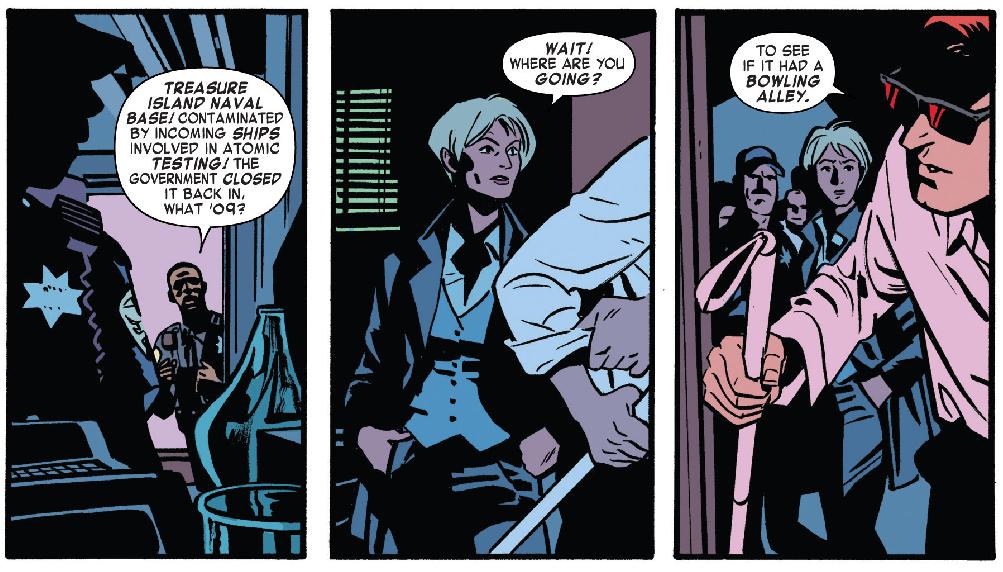
The issue starts at a San Francisco police station where Matt Murdock is lending his unique set of highly tuned senses to the search for a missing child. He puzzles together enough clues for one of the officers to conclude that the girl may be in the old Naval Yard on San Francisco’s Treasure Island. Matt believes she may be in a bowling alley on the island.
Daredevil Issue 1: Treasure Island reference
First Stop: Treasure Island Naval Yard
Treasure Island is a man-made land mass in the San Francisco Bay. The landmass is named for Treasure Island author Robert Louis Stevenson who briefly lived in San Francisco from 1879-80. It was built in the 30s as a federal Works Progress Administration project to provide a place to host the 1939 World’s Fair. The island became a Naval Base during World War II until it was closed in 1997. In 2008 the federal government sold Treasure Island to the city of San Francisco. Since that time there’s been a great deal of controversy over radiation levels and whether or not the island should have been opened for residential use.
(This is at least the second mention of Treasure Island in a comic book since August of last year. In Corinna Bechko and Gabriel Hardman‘s Station-to-Station a secret lab there creates dinosaurs, laser guns, and a massive tentacle monster.)
Berkeley-based Image Comics is preparing to release the first trade paperback of Chip Zdarsky and Matt Fraction's wildly successful time stopping sex romp Sex Criminals next month. The publisher announced…