Establishing the DC Shared Universe: Zatanna’s Search

In this modern age of comic-influenced pop culture we’re neck deep in shared universes and, increasingly, shared multiverses. It can be hard to imagine a time when that wasn’t the case. It can be even more difficult to believe we didn’t see the first true comic book shared universe until the mid-1960s. That’s when the daughter of the third most important character to debut in Action Comics #1 arrived on the scene in a quest to find her father. Zatanna’s search would take her on a winding path through six DC titles. As a result, it impacted several heroes and had repercussions on the DC Universe as a whole.

Zatanna's Search Justice League issue 51
Justice League of America Vol. 1 #51

Characters with their own titles crossing over with other characters is a common occurrence going all the way back to the birth of superhero titles. It’s difficult to pinpoint who can lay claim to the first ever superhero crossover.

The honor could possibly go to Lev Gleason Publications in 1940. That publisher teamed up the characters Silver Streak and Daredevil (not that Daredevil). It just barely preceded the first known team up of Marvel characters.  Marvel Mystery Comics #8 featured Namor and Human Torch going head-to-head for the first time. For DC characters, the first crossover medal goes to All-Star Comics #3 which saw the first appearance of the Justice Society of America. At the time, it was likely the biggest crossover in terms of number of characters featuring Flash (Jay Garrick), Green Lantern (Alan Scott), Hawkman (Carter Hall), Spectre (Jim Corrigan), Hourman (Rex Tyler), Sandman (Wesley Dodds), Doctor Fate, and Atom (Al Pratt).
(more…)

Continue ReadingEstablishing the DC Shared Universe: Zatanna’s Search

DC’s editorial department back in spotlight as Batwoman’s creators step down

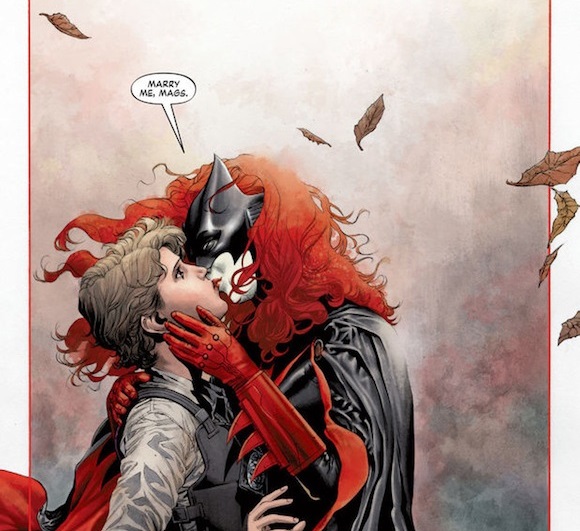
Batwoman proposal from issue 17.

Last night J. H. Williams III and W. Haden Blackman announced that they’re leaving Batwoman after 26 issues due to editorial interference that included being “prohibited from ever showing Kate and Maggie actually getting married.” Williams followed up the posting of his letter on Twitter with the comment “But must clarify- was never put to us as being anti-gay marriage.”

No one except those who were in the editorial board room knows if this decision was based on a company policy against DC’s LGBT characters getting hitched. It would seem odd in light of the company’s increasing comfort with prominent LGBT characters including Batwoman, Midnighter, Apollo, Sarah Rainmaker, Alysia Yeoh, and Alan Scott. What we do know is that DC erased every major character marriage — most notably the marriage between Superman and Lois Lane — when they relaunched the DC Universe in 2011. That suggests DC may have a policy to limit the marriage of title characters — no matter their sexual orientation. DC has never declared that limiting marriages is a policy.

No matter the justification for denying the marriage, the departure of Blackman and Williams once again brings negative attention to DC’s editorial department, who seem to have an increasing problem of not trusting some creators while putting too much faith in others.

The story Williams and Blackman have been telling is unique in the DC Universe, as they’ve had the freedom to tell it in a bubble without needing to shape their arcs around pesky multiple-title event storylines. Batwoman and Batman, Inc. were the only Bat-books given the luxury to sit out both “The Court of Owls” and “Death of the Family.” The result, free of crossover interruptions, is a complete story that can be read straight through from the first issue. Its lead character is also one of the best developed characters in the new 52. (more…)

Continue ReadingDC’s editorial department back in spotlight as Batwoman’s creators step down